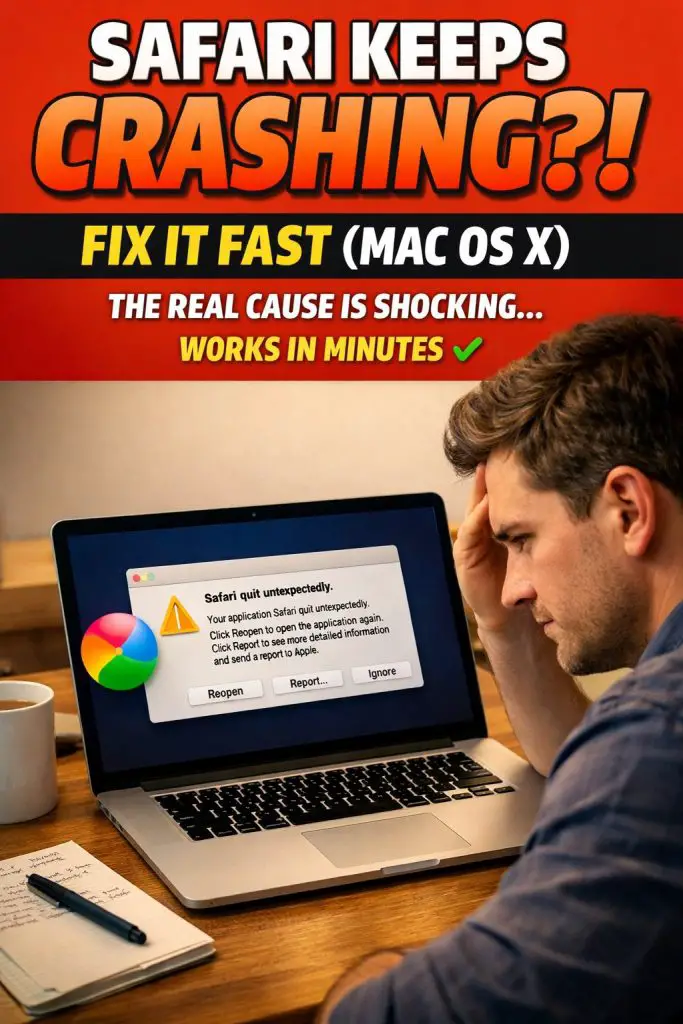
If your Safari keeps crashing in Mac OS X, I totally get how annoying that feels. One minute you’re trying to open a simple website, and the next minute Safari quits, freezes, or disappears like it’s had enough of the internet for the day. Sometimes it crashes as soon as you launch it, and other times it crashes right in the middle of browsing, watching a video, or opening multiple tabs. Either way, it can make your Mac feel broken even when everything else is working fine.
I’ve dealt with this issue more times than I’d like to admit, and honestly, it always shows up at the worst time. In my opinion, Safari crashing is extra frustrating because it’s Apple’s own browser, so you expect it to be smooth and stable. I think the good news is that most Safari crashes in Mac OS X have very fixable causes. And in this guide, I’ll walk you through the best solutions step-by-step, without confusing tech jargon.
By the end of this article, you’ll have a clear plan to stop Safari from crashing, figure out what’s triggering it, and get back to browsing normally. Whether Safari is crashing on startup, crashing when opening a specific website, or quitting randomly, I’ve got you covered.
Why Safari Keeps Crashing In Mac OS X (The Real Reasons)
Before we jump into fixing it, it helps to understand what’s usually behind the problem. Safari doesn’t crash “for no reason.” Most of the time it’s one of these issues:
- Corrupted cache or website data
- A buggy extension (or too many extensions)
- Outdated Safari or Mac OS X version
- Low storage space affecting performance
- Problematic website scripts (especially heavy ads)
- Damaged Safari preferences or corrupted files
- Conflicts with security software or VPN apps
- Too many tabs or memory pressure
And yes… sometimes it’s a combination of two or three things at once.
The best approach is to start with the simplest fixes first, and then go deeper only if you need to.
Quick Checks Before You Do Anything (Small Fixes That Often Work)
Let’s do a few fast checks that fix the problem for a surprising number of people.
Restart Safari the right way
If Safari is freezing or crashing repeatedly, don’t just keep reopening it immediately.
Try this instead:
- Close Safari completely
- Wait about 10–15 seconds
- Reopen it normally
If it crashes instantly, we’ll handle that in the next section.
Restart your Mac
This sounds basic, but it matters because it clears out temporary memory issues.
- Click the Apple menu
- Choose Restart
- Open Safari again after reboot
If Safari works after restarting, it may have been a short-term memory issue.
Check your storage space
Low storage can make Safari unstable, especially on older Mac OS X systems.
- Click Apple menu → About This Mac
- Go to Storage
- Try to keep at least 10–15 GB free, if possible
If your storage is almost full, Safari might crash more often when loading heavy pages.
If Safari Crashes Immediately On Launch (Best Fixes First)
This is the “ugh” situation where Safari won’t even stay open long enough for you to click anything.
Start Safari without restoring tabs
Sometimes Safari crashes because it tries to reopen a bad website or broken tab session.
Here’s the trick:
- Hold down the Shift key
- While holding it, click the Safari icon to open Safari
- Keep holding Shift until Safari fully opens
This often stops Safari from loading your old tabs automatically.
✅ Takeaway: If Safari opens fine this way, a tab or website was likely crashing it.
Boot Safari in Safe Mode (indirect but helpful)
Safe Mode checks your disk and disables some background items.
To enter Safe Mode:
- Shut down your Mac
- Turn it back on and immediately hold Shift
- Log in (you’ll see “Safe Boot” in the menu bar)
- Open Safari and test it
If Safari works fine in Safe Mode but crashes normally, it often points to extensions, login items, or system-level conflicts.
Clear Safari Cache, Cookies, and Website Data (Most Effective Fix)
If you ask me what fixes Safari crashes the most, it’s this. Corrupted website data can break Safari in weird ways.
Clear website data in Safari
- Open Safari
- Go to Safari → Settings (or Preferences on older versions)
- Click Privacy
- Click Manage Website Data
- Click Remove All
This removes cookies and stored site data. You may have to log back in to websites, but it’s worth it.
✅ Important: This can fix Safari crashing on specific websites.
Clear Safari history (optional but helpful)
- Safari → History
- Click Clear History
- Choose all history
- Confirm
This can reduce crash loops caused by repeated loading of a problematic site.
Disable Safari Extensions (Extensions Cause SO Many Crashes)
Extensions are useful… until they’re not. Some old Safari extensions were never updated properly for certain Mac OS X versions.
Turn off extensions completely
- Safari → Settings
- Click Extensions
- Uncheck all extensions
Now test Safari for a few minutes.
If Safari stops crashing, one of your extensions is the culprit.
Find the problematic extension (the smart way)
Turn extensions back on one-by-one:
- Enable one extension
- Use Safari for 2–3 minutes
- If it stays stable, enable the next one
As soon as Safari crashes again, the last extension you enabled is likely causing the issue.
✅ Best practice: Remove any extension you don’t truly need.
Update Mac OS X and Safari (Outdated Versions = More Bugs)
Safari depends heavily on macOS system files. If your system is outdated, Safari can crash more often.
Check for updates
- Apple menu → System Preferences
- Click Software Update
- Install updates if available
Even a small update can patch Safari stability problems.
FYI: On older Mac OS X versions, Safari updates sometimes come through system updates, not separately.
✅ Takeaway: Keeping macOS updated is one of the easiest long-term fixes.
Check for Problem Websites (Some Pages Can Crash Safari Instantly)
Have you noticed Safari only crashes when you visit one specific site? That’s a big clue.
Test Safari with a “clean” website
Try these:
- Apple.com
- Wikipedia
- A simple blog site
If Safari works on those but crashes on one particular page, the issue could be:
- Heavy ads
- Bad scripts
- Corrupted cache for that domain
Fix Safari crashing on ONE website
Do this:
- Clear website data (Privacy settings)
- Open the website in a Private Window
- Safari → File → New Private Window
- If it works in private mode, it’s probably cached data or cookies causing the crash
✅ If the site keeps crashing Safari no matter what, open it in Chrome or Firefox temporarily.
Reduce Safari Memory Load (Too Many Tabs = Chaos)
Safari is efficient, but on older Mac OS X systems, it can still struggle.
If Safari keeps crashing while browsing, especially with multiple tabs open, it may simply be overloaded.
Close unnecessary tabs (and stop auto-playing pages)
Try:
- Keep 5–10 tabs open max (for now)
- Close video-heavy pages
- Avoid opening 10 links at once
Quit other apps temporarily
Safari shares system memory with everything else.
Close apps you don’t need, like:
- Video editors
- Heavy games
- Lots of background utilities
✅ Tip: If you run Safari + a bunch of apps + low RAM, crashes are more likely.
Reset Safari Settings (Without Losing Your Mind)
Safari doesn’t have a single “reset button” anymore like in old versions, but we can still reset the major parts manually.
Here’s the “reset style” checklist:
- Clear history ✅
- Clear website data ✅
- Disable extensions ✅
- Remove custom settings you don’t use ✅
If Safari still crashes, we go deeper.
Fix Safari Preferences and Corrupted Files (Advanced But Powerful)
Sometimes Safari keeps crashing because a preference file is corrupted. This is more common after system changes or sudden shutdowns.
Remove Safari preference files (safe method)
Important: This is slightly advanced. If you’re not comfortable, skip to the next section.
- Quit Safari
- Open Finder
- Click Go in the menu bar
- Hold Option and click Library
- Open the Preferences folder
- Find:
com.apple.Safari.plist
Move it to the desktop (don’t delete it yet).
Now restart Safari.
✅ If Safari works after this, the preferences file was likely corrupted.
Check Activity Monitor (Safari May Be Crashing Because a Process Spikes)
This is super useful when Safari keeps freezing and then crashing.
Use Activity Monitor
- Open Applications → Utilities → Activity Monitor
- Search for “Safari”
- Watch:
- CPU usage
- Memory usage
- If Safari spikes hard every time it loads a page, it may be struggling with:
- A website script
- A bad extension
- A plugin
✅ If a specific website causes spikes, avoid it or try it in private mode.
Disable Problem Login Items (Background Apps Can Mess With Safari)
Some apps run silently in the background and interfere with Safari, especially:
- VPNs
- Ad blockers
- Security software
- “Mac cleaner” apps
Turn off login items
- Apple menu → System Preferences
- Go to Users & Groups
- Click your account → Login Items
- Remove anything you don’t recognize or don’t need
Restart your Mac and test Safari again.
IMO, this step is underrated. I’ve seen Safari crashes disappear after disabling just one weird background utility.
Check for Malware or Adware (Yes, Even on Mac)
Let me be clear: Macs are safer, but not immune.
If Safari keeps crashing and you also notice:
- Random popups
- Weird redirects
- Your homepage changed
- Strange toolbars
…then you might have adware.
What to do:
- Remove suspicious Safari extensions
- Check installed apps you don’t remember installing
- Avoid sketchy “free video player” downloads
✅ Golden rule: If an app promised to “speed up your Mac instantly,” be suspicious.
Create a New macOS User Account (Great for Testing)
If Safari crashes only in your account, but works in another, it points to user-level settings being the issue.
Test with a new user account
- System Preferences → Users & Groups
- Click the lock icon and enter your password
- Click + to create a new user
- Log out and log in to the new user
- Test Safari
If Safari works perfectly in the new account, your original profile may have:
- Corrupted Safari settings
- Extension conflicts
- A bad cache state
✅ This doesn’t “fix” Safari instantly, but it confirms the root cause.
When You Should Consider Reinstalling macOS (Last Resort)
Safari is built into macOS, so you can’t truly uninstall and reinstall Safari alone in Mac OS X the way you might on Windows.
But if Safari crashes constantly even after everything above, and other Apple apps also behave weirdly, macOS system files might be damaged.
Signs of deeper macOS issues:
- Safari crashes + Finder crashes too
- System settings lag badly
- Frequent beachball spinning
- Crashes after every reboot
At that point, reinstalling macOS (without erasing your data) can refresh system files.
✅ Tip: Always back up before doing this.
The Best “Fix Order” If You Want the Fastest Result
If you don’t want to try everything, here’s the exact order I’d follow:
- Restart Mac
- Open Safari while holding Shift
- Clear website data
- Disable extensions
- Update macOS
- Test problem websites in Private Mode
- Reset Safari preferences file
- Disable background login items
This gives you the best results with the least stress.
Final Thoughts (You’re Not Alone, Safari Crashes Happen)
If Safari keeps crashing in Mac OS X, don’t panic. It usually doesn’t mean your Mac is dying or broken. Most of the time, it’s caused by corrupted website data, extensions, or a system update mismatch.
Once you clean things up and remove the troublemaker, Safari usually goes back to being stable and fast again.
And if you’re still stuck after trying the main fixes, you can always tell me what happens right before Safari crashes. Like… does it crash on launch, after typing in the search bar, or on a specific site? That detail makes troubleshooting way easier.
FAQ: Safari Keeps Crashing In Mac Os X, Casues And Fixes
1) Why does Safari keep crashing on Mac OS X suddenly?
Safari often crashes suddenly due to corrupted cache data, a buggy extension, or a conflict after a system update. Clearing website data and disabling extensions are usually the fastest fixes.
2) How do I stop Safari from crashing when opening a specific website?
Open the site in a Private Window first to test it. If it works there, clear the website’s stored data using Safari → Settings → Privacy → Manage Website Data, then reload the page normally.
3) Can low storage cause Safari to crash?
Yes. Low storage can slow down system processes and cause instability, especially during heavy browsing. Keeping at least 10–15 GB free helps Safari run more smoothly.
4) Do Safari extensions make Safari crash?
Absolutely. Outdated or poorly coded extensions can crash Safari, freeze tabs, or cause unexpected quitting. Disable all extensions and re-enable them one at a time to find the culprit.
5) What if Safari keeps crashing even after clearing cache and disabling extensions?
If Safari still crashes, the issue may be due to corrupted preference files, login item conflicts, or system-level problems. Resetting Safari preferences and testing Safari in a new user account are strong next steps.